|
| |
History of Olympos
Olympos is believed to be a pre-greek word for mountain. Over twenty peaks bear the
name and, in many cases, gave it to an adjacent town or city. The ancient city therefore
takes its name from Tahtali Daği, (wooden mountain) an ancient Mt Olympos 16km to the
north with the eternal flame still burning in its foothills. The foundation date of the
city is unclear, as no Lycian tombs or inscriptions have been found. Fist mentioned in the
2nd century BC, Olympos became the Principal City on eastern Lycia.
Chımearea (The Eternal Flames)
The Yanartaş burning stone is situated 250m above sealevel
in the Çirali Valley. From the foot of the hill it takes 20-30 minutes to walk up to the
main set of flames. At present there are about 20 sets of flames in an open rocky area set
in the middle of the forest. A path also continues up to a second set at the crest of the
hill which are not so impressive.
|
| As early as 4 BC the flames are mentioned by ancient
authors, and the ruins set in front of the flames are of a late Byzantine Church. |
|
Analysis
of the flames has reported a percentage of methane gas from the vents; some of the
flames are easily extinguished by smothering with soil, but will re-ignite seconds later.
For optimum effect they are best viewed at night but don't forget to carry a torch for the
journey up and down. |
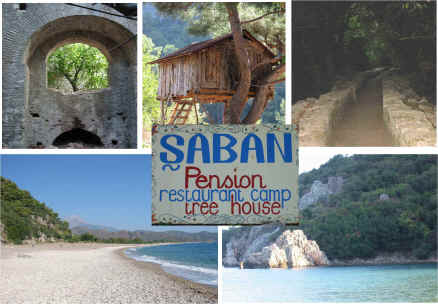
| Ask your friendly hosts Meral or Ali at Şaban Pension to
organise a tour of the flames. Your english speaking guide Huseyin will accompany you to
the Eternal Flames. |
Ruins of Olympos
The ruins of Olympos differ from many other ancient sites in that
nature's vegetation is the last conqueror of the city. In recent years a small amount of
excavation work has taken place and a network of footpaths have been cleared to make the
site more accessible. The setting has a mystical charm and an exploration of the ruins is
not just a historical adventure but a walk through a natural paradise full of the scents
and sounds of flora and fauna.
 |
 |
 |
Harbour Walls
Built in coursed polygonal masonry popular in the early Hellenistic period if this
dating is reliable the city could not have been founded much after 300 BC. |
Temple Doorway
The doorway stands 5m high, with decorated lintel and uprights dating to the 2nd
Century AD. It is built into a wall of regular smooth faced ashlar masonry. At the foot of
the door lies a statue base dedicated to the emperor Marcus Aurelius in the year 172-175
AD. |
Sarcophagus
A rather over the top design of late Roman period found in the South
Necropolis. |
Other ruins worth visiting include the Canal Water System which is now the walkway to the
Mosaic Building which contains original intact mosaic flooring. Ask your hosts for the
guide book to the Olympos ruins which contains a detailed map of the area. |
|
Cruise to Fethiye
|
The cruise takes 3 nights and 4 days and travels from Olympos to Fethiye.
Fun, sun and sail departs every three days and costs £85. All meals included, drinks
available on board. Check availability on arrival. |
 |
Other Activities
Turtle Sanctuary - On the road leading into Olympos visit
the turtle sanctuary and the hundreds of baby turtles. The breeding season is May to
October. The beach at Olympos and Çirali is 3.2km long and ¾ of the beach is suitable
for nesting sites.
Day Hike Yanar to Ulupinar Loop - A five hour return hike
ascending to the Eternal Flames. Check with your hosts for detailed information regarding
this and other hikes throughout the area. |
|